
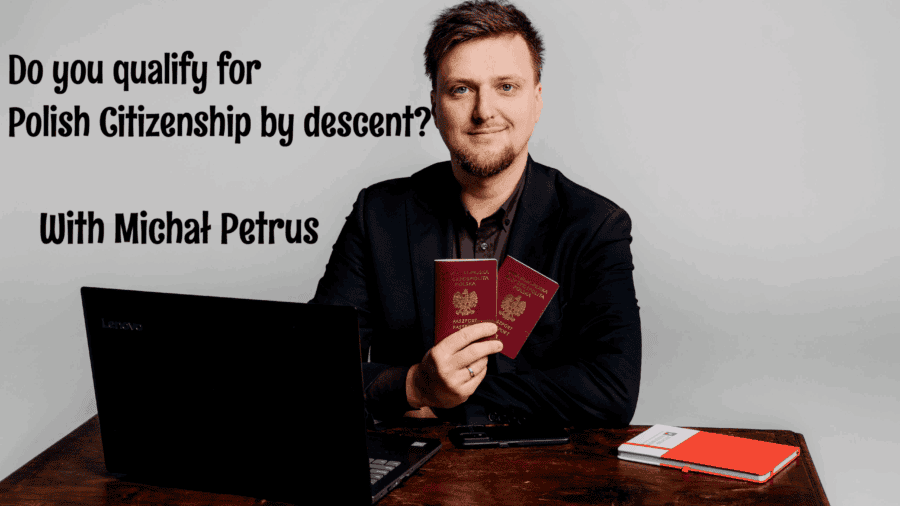
If you’re wondering whether you qualify for Polish citizenship, this post explains the key legal principles behind Polish citizenship by descent and discusses the most common eligibility scenarios. You will find out:
- Who can qualify for Polish citizenship by descent
- How Polish citizenship is passed on to next generations
- The most common reasons people do (or do not) qualify for Polish citizenship
- Which documents are usually required to get Polish citizenship confirmed
This post was inspired by a recorded webinar on the topic of Polish citizenship by descent. The host of the webinar was Michał Petrus. Michał has kindly given Finding Poland permission to do a write-up based on the webinar. Michał is a historian, genealogist, and leading Polish citizenship expert at Get Polish Citizenship, a citizenship firm based in Kraków, Poland.
I have interviewed Michał for Finding Poland a number of times since our first meeting in November 2023. We have explored a variety of topics, including the confirmation of Polish citizenship for American citizens of Polish descent and obtaining Polish citizenship by Presidential grant.
Who can qualify for Polish citizenship by descent?
All descendants of Polish male and female citizens are entitled to have their Polish citizenship confirmed by the authorities in Poland. However, there are some caveats:
1. Before 1951, it was much less likely for a Polish female to have preserved her Polish citizenship. This is because women’s citizenship prior to 1951 was prone to a loss owing to the adoption of another citizenship through naturalisation or marriage. After January 19, 1951, it no longer resulted in the loss of a female’s Polish citizenship.
Overall, it is easier for descendants of Polish citizens to trace their citizenship in a male lineage.
2. Between 1920 and 1951, there were also some grounds for the loss of Polish citizenship. These reasons include holding a public office abroad or taking up foreign military service. An exception to this rule was service in Allied military services during the Second World War.
Contrary to popular belief, naturalisation, such as obtaining British citizenship, didn’t always equate to the loss of Polish citizenship. Between 1920 and 1951, a major reason why men accidentally retained their Polish citizenship despite emigrating and taking up foreign citizenship was due to a legal loophole known as the Military Paradox. Under Polish law, an adult male could not legally lose his Polish citizenship by naturalising abroad unless he had obtained formal consent from the Polish Ministry of Interior or the Ministry of Military Affairs. If he hadn’t cleared his military service obligations with Poland, his foreign naturalization was considered unauthorized and legally void, and Poland still viewed him as a citizen.
Finally, it’s important to mention that there is no language competency or residency requirement to initiate the process of obtaining Polish citizenship by descent. This is in contrast to the acquisition of Polish citizenship on the basis of marriage where residency and language competency demands are placed on the applicant.
What are the rules for automatic acquisition of Polish citizenship by descent?
Polish citizenship is determined by Jus Sanguinis – the “rule of blood” (prawo krwi).
This means that you can inherit Polish citizenship even if you are not born on Polish soil. We need to distinguish Jus Sanguinis from Jus Soli, or “Right of Soil”, which is prevalent throughout the Americas. Countries such as the USA, Canada and Brazil automatically grant citizenship to almost every child born within their borders, irrespective of their parents’ immigration or legal status.
The main advantage of the rule of blood is that descendants of Polish citizens are able to claim their citizenship, even after many years have passed and many generations were likely to have been born outside of Poland.
The major drawback of the rule of blood is that vital records such as birth certificates and marriage certificates from Poland do not prove citizenship itself.
Contrary to popular belief, there is no limit of generations for Polish citizenship via blood. Moreover, neither your parents nor your grandparents need to confirm their citizenship first. You can do it directly.
Steve: Speaking personally, my father and I applied to have our citizenship confirmed at the same time.
The Main requirements for obtaining Polish citizenship by descent
There are several conditions you need to meet to qualify for Polish citizenship by descent. Let’s dive in:
Requirement 1 – Keeping key twentieth century dates in mind
With regard to a Polish ancestor who was a citizen of the Second Polish Republic (1918-1939) or the former partition empires of Russia, Germany and Austria-Hungary, that ancestor should have lived in a place that later became Poland.
Many citizenship firms do not support applications that pre-date the Second Polish Republic or even 1920. They tend to cite that the 1920 Polish Citizenship Act was the first to describe Polish citizenship. That may be true – post-1920 cases are generally much easier for citizenship specialists to solve. However, even if one’s ancestor/s left Poland before 1920, it still may be possible to confirm the descendant’s Polish citizenship. There are just more factors to be crosschecked against various laws and treaties. As for documents, the following tend to suffice for the aforementioned empires:
- Germany – ‘right of domicile’ residency document (Heimatrecht)
- Austria-Hungary – certificate of municipal belonging (certyfikat przynależności do gminy); a historical Austro-Hungarian legal certificate that established an individual’s municipal citizenship (Heimatrecht)
- Russia – population census
As previously mentioned, Polish women were less likely to have kept their Polish citizenship before 1951. In many countries, marriage resulted in the automatic adoption of citizenship of the female spouse. However, certain countries – such as the US in 1922 and the UK in 1950 – abolished citizenship by marriage.
Requirement 2 – Relevant documentation
Historic documents proving your ancestry must be presented to the Polish Government. A single document usually suffices.
Examples of original documents, or hard copies with a stamp, include old Polish passports, early Polish identity cards (dowód osobisty), population censuses, domicile lists, voters lists, military draftees/conscript lists, other military documents, tax or property records and notary documents (deeds).
Documents which do not prove Polish citizenship are: school records, vital records (birth/marriage/death records), memorabilia, medals and association cards.
Supporting documents need to be originals or certified copies, with physical authentication from the government of Poland – central or provincial. Scans, pictures, xerox copies, and photocopies are not accepted.
Military records are the most common type of documentation for British citizens of Polish descent who wish to have their Polish citizenship confirmed. Many of their Polish ancestors were first of all deported from Polish territory by the USSR to various places, including Siberia. They followed the Anders Army trail through Iran, Palestine, Italy and other countries. Even civilians followed the army and ended up in Polish settlements in Africa or India. All in all, the British Ministry of Defence possesses very well preserved records which detail the service of Polish soldiers under British command. Such records serve as excellent proof of Polish citizenship.
Other documents that are present in The State Archives in Poland include population censuses, voters’ lists, tax property records, and domicile books. These records prove that an ancestor legally inhabited Poland during the Second Polish Republic (7 October 1918 until 6 October 1939).
It is important to reiterate here that birth, marriage and death records do not prove citizenship itself. Vital records may be used as supporting evidence to show a continuity of events which took place in Poland.
Requirement 3 – Proof of descendancy
In order to qualify for Polish citizenship, you need to prove you are a descendant of a Polish citizen. This is done with birth and marriage records showing parents’ names. For citizenship to be passed down through the paternal line, you have to confirm that you were born in wedlock.
You will also need non-Polish documents proving your ancestor didn’t lose citizenship (mostly military service and naturalisation documents). This applies to the period between 1920 and 1951. The Polish government may also wish to see the ancestor’s public office status.
Common myths regarding the acquisition of Polish citizenship by descent
On the topic of claiming your Polish citizenship by descent, here are some common myths:
- I need multiple ancestors to be Polish – For citizenship by descent, you only need one viable lineage
- The need to be an ethnic Pole or Catholic – This is certainly a myth. The Second Polish Republic was highly diverse as it contained, for instance, Protestant Germans, Greek Catholic Ukrainians and Orthodox Belarusians, all of whom were entitled to Polish citizenship.
- An ancestor’s name change will throw my claim for Polish citizenship up in the air – The bottom line here is that you need a document to prove the name change. Of course, the government is tolerant of the fact that your ancestor was called, for example, Piotr in Poland and Peter in the UK. However, for a surname change, you would need a deed poll or the presence of a name change on the ancestor’s naturalisation certificate.
- No one in the family has claimed their Polish citizenship by descent before – You may still qualify for Polish citizenship regardless of where you fall in the family line
- I need to speak Polish – No, it is not a requirement to speak Polish or pass a Polish language exam to claim your Polish citizenship by descent.
- Polish citizenship law is going to change soon – While it is true that plans are afoot for the Polish Government to tighten the law connected with certain pathways to acquiring Polish citizenship, such as residency and via presidential grant, they cannot do it to the citizenship by descent pathway. The reason is because citizenship by descent is based on previous citizenship laws and therefore the Government cannot retroactively revoke your ancestors’ Polish citizenship.
- An applicant’s birth certificate alone will suffice – Being born in Poland (Jus Soli) is not proof of citizenship. After all, it’s possible to be born on Polish soil and still be a foreigner.
How does the process of Confirmation of Polish Citizenship work?
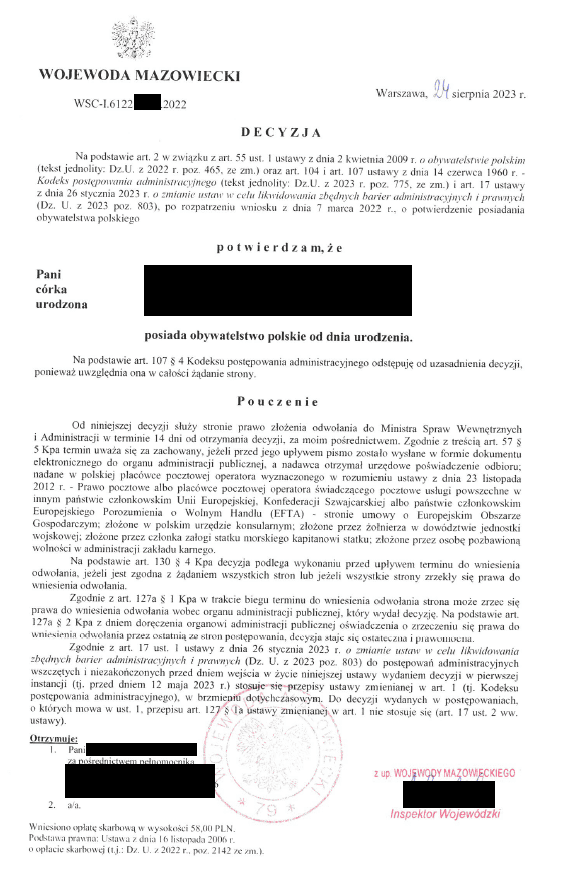
When you are preparing for the Polish citizenship by descent pathway as a descendant of a Polish citizen, do have in mind that you are a Polish citizen yourself from the moment of your birth (the rule of blood – Jus Sanguinis). Overall, the purpose of your application is to prove you are a Polish citizen from the moment of your birth. If you can do that, the government has no choice but to confirm your Polish citizenship and present you with a certificate.
With this citizenship certificate you are then able to request a Polish passport at your Polish consulate or embassy. In most cases, confirmation of citizenship takes place at the Mazovian Provincial Office in Warsaw (Mazowiecki Urząd Wojewódzki w Warszawie). This is due something known as właściwość in Polish Rule of Law. Essentially, everyone that has a domicile outside of Poland has their office in Warsaw. If you are already living in another voivodeship in Poland, then you should apply for citizenship at the provincial office in that voivodeship.
In order to acquire a Polish passport, you will also need to have your Polish vital records registered. This process demands that you send your birth and/or marriage certificate from your country of origin to Poland to be translated by a sworn translator. The source vital records and sworn translations are then forwarded to the Polish Registry Office. Reputable specialists – such as Michał Petrus – will of course organise the whole process for you, including the sworn translations. The Polish version of your birth certificate is required to apply for your Polish passport.
In 2025, the Mazovian Voivodeship Office in Warsaw received 25,000 applications. Given that a team of just eight staff members handles the workload, the process is notoriously slow and certainly not for the impatient. As of August 2026, the government estimates that the waiting time for one’s Confirmation of Polish citizenship stands at around 24 months.
FAQ – Do you Qualify for Polish Citizenship by Descent?
The answer to this question depends on the number of years that have passed since the birth of your Polish ancestor. For instance, if your father was born in 1930, it is less than 100 years since the event. This means that the birth certificate should still be with the registry office in Poland. If the birth certificate is older than 100 years, it should be in the Polish State Archives (Archiwa Państwowe).
For marriage and death certificates, the number of years drops to 80 for its storage in the registry office.
For legal procedures related to the acquisition of Polish citizenship, you do require an address in Poland so that the appropriate provincial office can send letters to you. If you have not got an address in Poland, you should seek the services of a Power of Attorney for Delivery (pełnomocnik do doręczeń). Therefore, you can rely on a reputable Polish citizenship company to handle your legal correspondence using their postal address.
In the future, it is expected that citizenship cases will be handled online via Poland’s official digital system for sending and receiving legally binding mail (e-Doręczenia).
This issue is extremely relevant to many families based in the UK because many ancestors of Brits with Polish descent may have come from a place called Kresy. This is a historical region of the eastern part of the Second Polish Republic which was granted to the USSR after the Second World War. From a legal perspective, ancestors from Kresy were still citizens of Poland regardless of the fact that the territory was ceded to the Soviet Union.
The only exception to the maintenance of their status as Polish citizens was if they remained in the USSR up until 1959. On May 8, 1958, the Convention between the Polish People’s Republic (PRL) and the USSR on the Regulation of Citizenship of Persons with Dual Citizenship came into force to eliminate overlapping citizenship claims following post-WWII border changes. Individuals who held citizenship in both nations had one year – until May 8, 1959 – to submit a formal declaration to forfeit the citizenship of the country in which they did not reside.
If a dual citizen did not file an active declaration by May 8, 1959, they automatically lost the citizenship of the state where they were not residing. For instance, a dual Polish-Soviet citizen living in the USSR who filed no opt-out declaration by May 8, 1959, legally lost Polish citizenship on that day.
Fortunately, most Polish persons who were descendants of British people left the USSR before the end of the 1950s through the civilian or military Anders Army trail or displaced persons camps.
I recommend descendants of Polish citizens to contact the Arolsen Archives in Germany. The Arolsen Archives – International Center on Nazi Persecution was formerly called the International Tracing Service (ITS). Descendants of Polish citizens can head to The Arolsen Archives Online Archive – a globally accessible digital database which holds documents pertaining to refugees and displaced persons, among many other groups.