
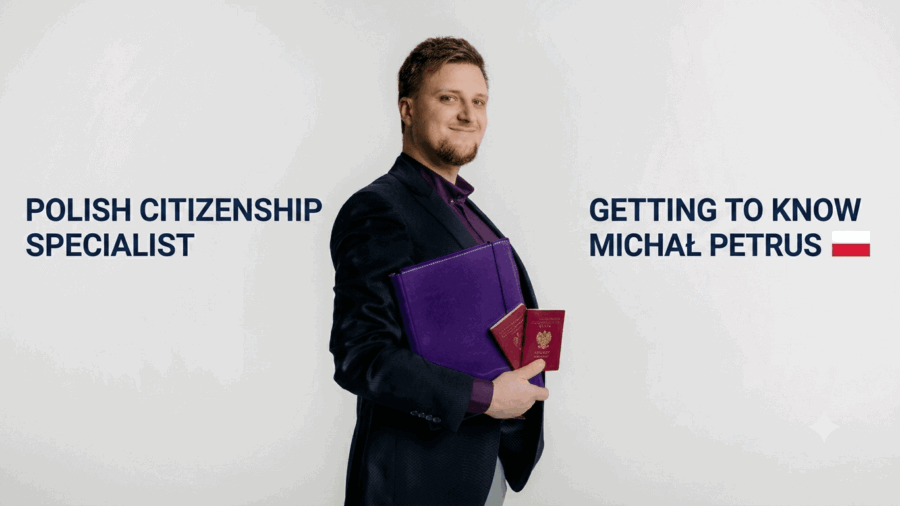
In an increasingly unpredictable world, a second passport is the ultimate “Plan B.” Navigating the complex web of European bureaucracy and changing historical laws requires more than just a birth certificate. You need a Polish citizenship specialist to cut through the legal jargon, sift through the documents you possess and search for missing documents.
Someone you can rely on to help reclaim your heritage is Michał Petrus, a historian, genealogist, and leading Polish citizenship expert at Get Polish Citizenship, a citizenship firm based in Kraków, Poland.
I have interviewed Michał for Finding Poland a number of times since our first meeting in November 2023. Always insightful and always honest, we’ve delved into topics ranging from Polish citizenship through Jewish ancestry to the kind of documents which prove Polish citizenship through ancestry.
This time – something different. We’re going to move away from the ins and outs of Polish citizenship law in order to get to know a bit about Michał himself.
It was with pleasure that I sat down with Michał in a cosy coffee shop in the heart of Kraków for a lighthearted interview.
Steve:
You know, Michał, even before I started secondary school, I was quite a precocious writer and invariably did better than my peers at spelling tests. Therefore, even though I studied history for my undergraduate degree, it’s perhaps no surprise that I am an English language teacher today. I was a bit lost during my undergraduate studies but everything naturally fell into place when I began to set my sights on teaching English in Poland towards the end of my degree.
You have had other roles in your career, such as Business Developer, Credit and Collections Analyst and Process Lead, but I wonder whether your progression to citizenship specialist was perhaps intertwined with fate when you look back on some of the skills and interests you had as a young child?
Michal:
❝ I never dreamt of becoming a Polish citizenship specialist, and quite honestly, I didn’t really expect to be working in the field that I love – history.
As far as I can remember, every teacher and work advisor told me that it’s impossible to get a good job as a history graduate. But I’ve always been very wilful, and I pursued it anyway. To their credit, they were partially right (laughing) – I struggled to secure a job after graduating in 2014.
For half a year, I did gig economy jobs, and then I joined an international corporation dealing with consulting and finance. Those positions were popping up here, there and everywhere back then. As long as you had some fluency in a foreign language that was not Polish, they were ready to train you in everything else. Fortunately, my English was not that bad. I appreciated the role; however, the work was rather mundane and very repetitive. I got promoted several times, but I was clearly yearning for more.
At the turn of 2018/2019, my long-time friend and fellow historian, Patrycja, recommended me to work, for the very first time, at a Polish citizenship firm. I was responsible for carrying out research – only – but over time, my curiosity got the better of me so I started to ask for more and more procedural work related to claiming citizenship for clients, up to the point that I was mainly doing that. It was very exciting. For the first time, I felt that the work I was doing was unique with every day bringing fresh challenges, and I was meeting and getting to know people from all over the world. The work was crazily busy, with waves of post-Brexit clients, but I felt so fulfilled. Combining my passion for history and old documents, with something that was really making a difference to somebody’s life – I was soon hooked. I knew that I could never work in finance or get a corporate job again. Knowing that I was doing a job which, realistically, only a dozen or so people could claim to be experts at was also nice. I began to feel as if I was really making my mark upon the earth – as a Polish citizenship specialist.
After several years of probing and trying, all the pieces fell into place. I was finally in the position to make a decent living as a history major, something that neither I nor my work advisors and teachers could ever have dreamed of. ❞
Steve:
Apart from history, which other subjects aroused your interest at school?
Michal:
❝ I’m quite ashamed to say that I wasn’t really a good pupil. I got good grades in history and English classes, and to an extent in my political [“Wiedza o społeczeństwie”] and geography classes too, but that’s about it.
With Polish, I always preferred to read books of my own choice, and not set texts forced upon me by the curriculum.
I do regret not engaging myself more in STEM classes, particularly physics. As I got older, I got hooked on astrophysics, and sometimes I wish I had a more solid knowledge base from school times.
I probably also should be more fluent in a number of languages, other than English, given that I had German, Italian and French classes as well. But I didn’t follow through with those. Right now I’m trying my best with Spanish – hopefully this one will stick. ❞
Steve:
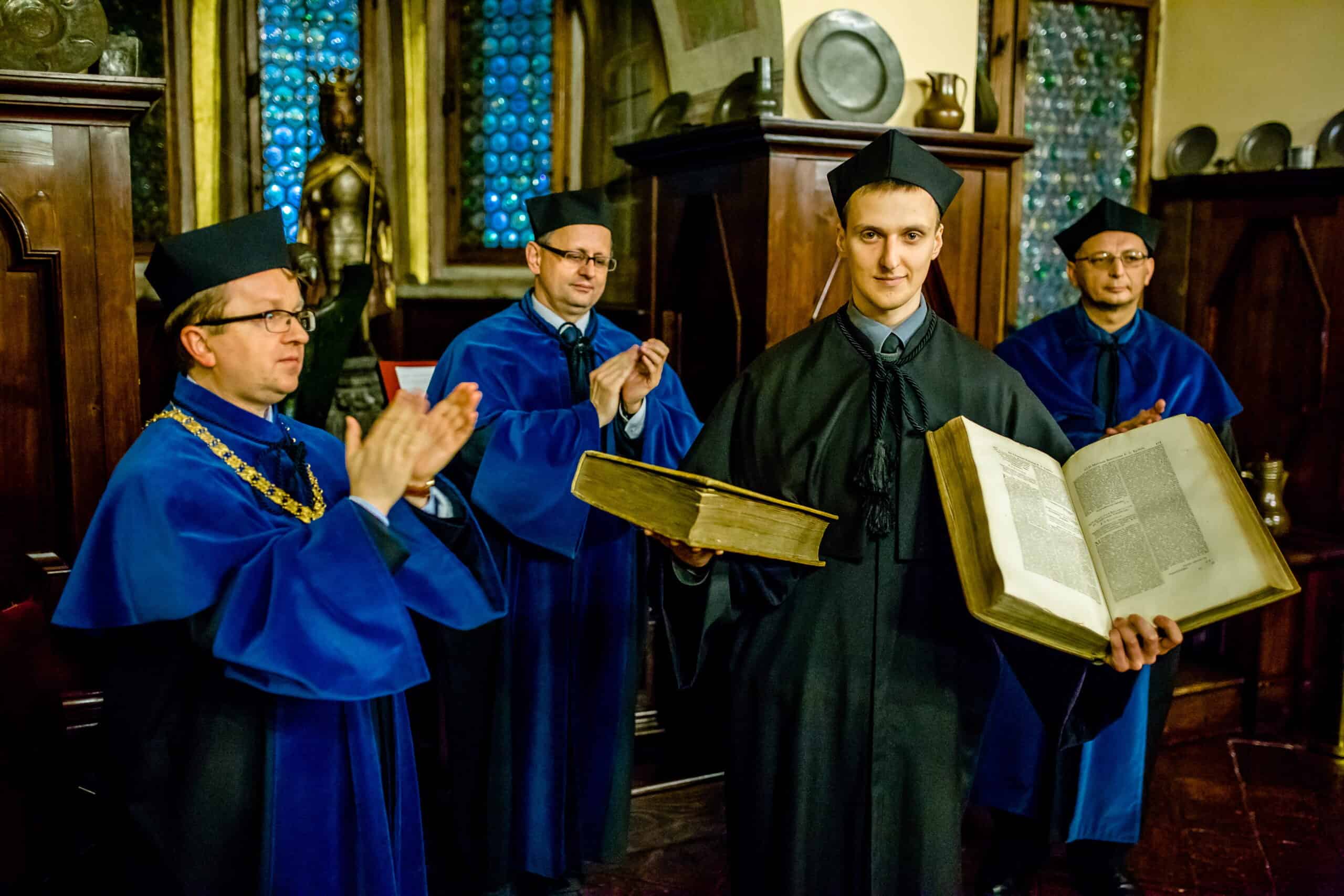
You graduated in 2014 with a master’s degree in history. What are some of your standout memories from your time at the Jagiellonian University in Kraków?
Michal:
❝ University was something different; I loved it very much. Especially the first year of my Bachelor’s degree. That’s probably because it was entirely dedicated to my one true love – history, and also, I was very independent with the whole idea. I didn’t have any family in Kraków and only one friend who I had previously met on the internet. My whole life revolved around Łódź and the small town of Koluszki in central Poland. I felt fortunate to be accepted by the uni, boarded the train, and never looked back.
The first day was crazy. I took the last 100 złoty bill from a drawer and bought myself a train ticket to Kraków. To my surprise, the department of history at Jagiellonian was undergoing renovation, so I struggled to enter the building. Another point is that they had a different set of specialities than at the University of Łódź, so I basically guessed which one would interest me the most.
I didn’t even have a place to stay in Kraków so I had to return to Łódź. However, the last train back to Łódź had already departed. I boarded the first available train to Warsaw, which was crazily expensive. With no money left to go from Warsaw to Łódź, I called my friend in Warsaw to meet me at the train station and lend me some cash. But even though I was exhausted, I was extremely happy. I think that’s the day that stuck with me the most.
As you can probably imagine, university life was buzzing with wonderful experiences and crazy parties too. No one parties like humanities students! ❞
Steve:
Which historical era, or eras, and events continue to fascinate you today?
Michal:
❝ It has changed a lot over time for me. As with many young students of history back at school, I was fascinated by the ancient period. Then, I became engrossed in the Medieval and Early Modern periods – both my Bachelor’s and Master’s degrees were on the matter of religion in the 16th and 17th centuries. After I graduated, I became more interested in the Early Medieval period, especially the 10th century in the Mediterranean basin.
Frankly, I’ve always tiptoed around more modern history. Twentieth century history has always been too gloomy and depressing for my taste. It’s ironic then that my work is tied to the twentieth century. I joked around that history ended with the Franco-Prussian War of 1871, and after that date you only get political studies.
I do my best to learn more all the time, as I feel I didn’t dedicate enough time to twentieth century history at university. It’s so much easier to advise clients and carry out research if you know how a client’s family history is connected to key historical events. ❞
Steve:
Let’s move on to speak about your work as a Polish citizenship specialist. Can you outline your experience – positive and negative – at the two citizenship firms you worked for before setting up Get Polish Citizenship?
Michal:
❝ With my first employer, I learned the ropes, and what I remember most fondly is that we had a very strong, integrated and lovely team. By the way, we still keep in touch and share our expertise in the most difficult cases. Anyway, I remember how we celebrated each milestone and the atmosphere there was very much family-like. Maybe it’s a cliche, but that’s what it was.
The covid pandemic crisis changed everything. The firm started to resemble a corporation more and more, and people started leaving.
My second assignment involved setting up a citizenship department. That was a huge challenge, but it was very rewarding. I was able to put my knowledge to the test, organise everything “my way” and start it all up.
I pitched the idea of a citizenship department to a genealogy firm, wanting to capitalize on their team of skilled historians and genealogists. Fortunately for me, they liked the idea. The atmosphere was much more stable, probably because I had two bosses and it balanced things out nicely. I also got to polish my skills – no pun intended – because this time I was doing everything myself – starting from sales, through to research, and ending up with handling applications. The work wasn’t divided into smaller departments, like at my first citizenship firm.
There was no drama upon leaving my second company. I left because of changes in my personal life, and I pride myself on the fact that even after my leaving, the firm in question mostly switched gears to citizenship. I created something solid. But it was still time for a change.
That’s the amount of detail I am comfortable sharing, without getting sued. The citizenship field is a small world; it’s best to be careful with those topics. ❞
Steve:
You decided to go solo then in April 2026, founding Get Polish Citizenship with Oskar Piechowski. How did the idea come about? Was it just a case of “it’s now or never”?
Michal:
❝ Yes. Precisely that, I had been toying with the thought since 2025, but as some of you probably know, opening up an enterprise in Poland is not for the faint-hearted, no matter how small the company is. Oskar encouraged me to make the move much earlier, to be honest. He is my childhood best friend and has always supported me. I finally took the plunge, but it was not easy to follow through. If you are a people pleaser like myself, it’s especially hard to let people down. I already had a department with two employees working under me, and I felt enormous gratitude to my bosses for letting me set up the department. I had to leave this all behind and focus on a new adventure.
I’m too sentimental – a veteran business manager would have scolded me that I failed to capitalise on massive waves of interested clients, first with Brexit, then with the Trump scare. But I remain optimistic and do not regret anything. I felt like I had learned my lessons and was ready for this next big step. The timing, for me, was just right. ❞
Steve:
In our previous interviews, we spoke a lot about helping Jewish people, British citizens and American citizens claim their Polish citizenship by descent. I’m sure you’ve helped confirm Polish citizenship to many descendants of emigrants from other countries as well. From a historical and archival perspective, which nationalities do you particularly enjoy assisting?
Michal:
❝ I have never really counted, but I must have handled over a thousand cases now. I particularly like working with the British and Australians, but it doesn’t mean I don’t like the others. I think it has much to do with the fact that even before my career, I had always liked British history, culture and humour. Both of my university theses were related to the history of the UK and Ireland.
With all cultures, you have to switch gears in a conversation, because they expect a different service and approach. Apart from the job itself being unique, what attracts me to it is meeting people from all over the world. From time to time, I also get to meet some of my clients in person here in Poland, which is always nice. I always feel bad when I have to break bad news to descendants from the east. Due to political decisions, citizenship by descent is mostly closed to Belarusians and Ukrainians. As for archival research, I’m overcome by a similar emotion when I see a client’s ancestors hail from the eastern part of Poland, or Warsaw, because the majority of records are gone forever. ❞
Steve:
Yes I am sure you cannot help but to get involved in your clients’ cases on an emotional level too when their hopes of acquiring Polish citizenship are sadly dashed. I do wonder – how do you handle those people who get desperate and simply won’t take no for an answer? It must happen very often right?
Michal:
❝ It happens quite often, and I empathise completely. If you feel Polish, you just feel Polish, and who am I – or really, the government – to tell you otherwise. Sadly, there is no such thing as historical justice within this field. The fact that current Polish citizenship law follows the very dated laws from 1920, 1951 and so on is both its blessing and a curse. It cannot be changed retroactively, so even an anti-immigrant government cannot make changes to the law. What is more, it’s simply wishful thinking to expert a more humane approach.
Back in 2014 in Czechia, new nationality legislation took effect to allow the restoration of citizenship for those whose parents or grandparents lost their Czech or Czechoslovak citizenship. But in Poland it’s still only possible for the person who renounced or lost citizenship, and no one else.
The only hope is that the judicial verdicts and interpretations of the more vague articles of Polish citizenship acts are revised. For instance, I have in mind the loss of Polish citizenship in relation to military service in allied armed forces and women’s dual citizenship if acquired on the same day (before 1951). Another source of confusion for many citizenship by descent cases concerns female ancestors as many women lost their Polish citizenship between 1920 and 1951 by, for example, marrying a foreign citizen. However, there were exceptions to this law.
I always want my clients to understand I am entirely on their side, and the only thing I want to avoid is them spending so much money and time – only to receive a denial letter. But there’s one avenue still left – Polish citizenship by presidential grant. It’s very arbitrary, again – for better and worse – and the sole power of the president is whether to grant citizenship or not. If you make your case properly, stressing not only that you have Polish ancestry but also a connection to Polish culture and heritage, you are in with a chance. That’s the “last resort” I can propose. ❞
Steve:
Finally – if you could make just one change to Polish citizenship law, what would it be?
Michal:
❝ I’m torn because there are so many injustices. But the one that always pains me the most is the whole “public office” thing. In the 1920 citizenship act, it was stated that a person who works for a foreign government loses his or her Polish citizenship. All “fine and dandy” if it’s a true government job, like being an MP, head of the department, etc. But the current interpretation is still very broad and includes trades like being a doctor, a teacher, or a rabbi. Just working in the public sector. It is punishing the descendants of people who succeeded in their new countries, learned another language, and made a career. It still causes hundreds of cases to be dismissed. So let’s start with that, but believe me, I have many other grievances with the government. ❞
Final Thoughts
I spent an extremely insightful 90 minutes with Michał in Kraków. He’s a crackerjack Polish citizenship specialist and a tremendous historian to boot.
If you want to check your eligibility for Polish citizenship, check out Get Polish Citizenship’s very own eligibility test.